Rites and Rituals
Our long lost wisdom machines

“And the Word became flesh”
- John 1:14
Kinaaldá
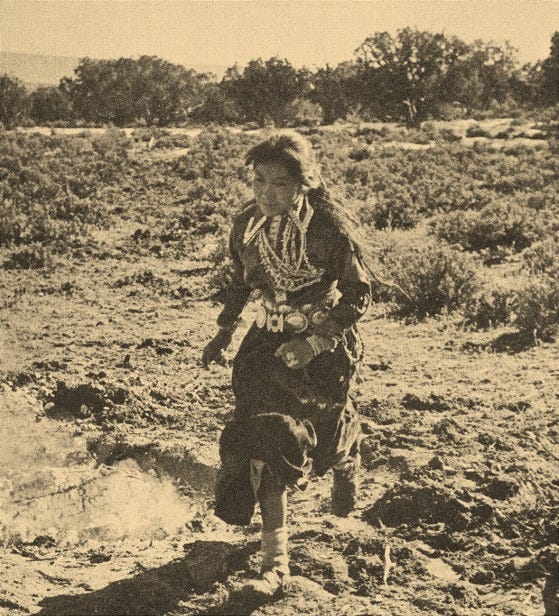
Dust stirs along the dry desert bramble as small footsteps hastily glide by blooming sage brush and greasewood. This arid southwest landscape is a witness at rest, for a young girl who is in the full motions of becoming.
Her dark hair shines in the rising sun along with the silver and turquoise jewelry she is adorned with. Like a jewel of the desert, she is radiant for those who wait for her; she is kinaaldá.
Having been in fast for days, eating only alkaan (specially prepared corn cake), her eastward strides bear a weight previously unknown to her. This is a task that her mother had performed, and her grand mother, and young women generations and generations before them; all their trialed foot steps now imprinted on this land which surrounds her.
“Their footsteps are mine, and mine theirs.” She thought.
The newborn sun pierces over the eastern horizon which she runs toward, casting intense beams of orange and violet onto her sweating brow, this is her final push, she is almost anew.
Now in a full sprint, kinaaldá rushes toward her loved ones that await for her as she awaits for the dawn. Her legs feel weak and her head is light, however, she is almost home. Kinaaldá arrives at the hogán (traditional Navajo underground structure used for both dwelling and ceremony), and their stand the women that have come before her, in flesh and spirit, waiting for the last stage of her investiture; the encountering of Changing Woman.
Wisdom Machines
The modern headspace is exactly that, heady.
I use this word in a twofold manner, first to describe the hyper intellectual nature of our individual and collective consciousnesses, and secondly to describe the intoxicating numbness that this overly cerebral mode of operation causes. Whether it be in the onslaught of dopamine stimulating content online, or our culturally secular emphasis on agnostic rationalism, the western psyche has an abundance of software, but absolutely no hardware; scholarly knowledge without any experiential wisdom.
What has our secular operations of world and thought then lost?
This, of course, is not the sole potential absence which has caused such occurrences, however, why hasn’t anyone taken a step back from the ongoing advance of western utopian intellectual structuralism, still running on the fumes of the enlightenment, to ask:
“Where did our rites and rituals go?”
Up until the past few hundred years, it has been common in cultural epistemologies that knowing needed to be adjoined with being; knowledge needed to be completed with experience. It is through this process alone that true wisdom is attained.
Our primordial predecessors seemingly grasped this concept intuitively, and in the spirit of needing to pass down sacred knowledge to the generation to come (along with many other reasons), rite of passage rituals were created.
Thus, the Navajo facilitate Kinaaldá.
In a dead sweat, kinaaldá arrives.
She is caught in the enveloping embrace of the matriarchy that has watched over her and is hence placed on her back stretched upon weaved blankets on the ground of the hogán, her head facing the rising sun.
Such as the Holy Peoples molded the first kinaaldá, Changing Woman, the girl is now molded by the matriarchal lineage into a woman herself.
Enmeshed with the hum of chant and song, kinaaldá is softly given physical form by the embracing matriarchy which surrounds her. Singing of the first kinaaldá, the traits of Changing Woman are placed upon the girl, granting her beauty, resilience, fertility, and strength.
It is in this moment, that a numinous synchronicity occurs, and the young woman is momentarily empowered with all the weight and authority of Changing Woman herself; deity and descendent are one, and in this state does she bless the men and women that have come before her. The young woman, animated in the spirit of divine femineity has oriented her youth behind her and is now integrated into the mythos of Changing Woman, into the portrait of the Navajo feminine.

Our Long Lost Becoming
The word kinaaldá in this instance, can thereby be an approximate culturally specified synonym to the word liminal. A kinaaldá is no longer a girl, yet not a woman; she has not become but yet is becoming.
The western world finds itself in this liminal transition, venturing from primordial structures of thought and behavior into a transient cerebralism of modernity, not knowing our way forward. Put simply, we left the shores we once knew in search of foreign land, but now having found such foreign soil, we have no clue as to where we came from, hence we are just as lost as we were prior.
If we are to follow the developmental stages of becoming specified in ritual (familiarity, liminality, numinosity, integrity), then we must, such as kinaaldá, face ourselves toward the east and run toward the animating numinous mystery that breathes life back into the secular intellectualism that we have made our idol.
Do we have the courage to lean upon our ancestors and elders?
Do we have the courage to fast, eating nothing but the bread or alkaan our forefathers once lived upon?
These are the questions that open one to the aridity of the spirit, the place of the still desert. It is through this descent into unknowing, that we find a ‘knowing’ greater than what we had ever before.